
Alvin Market Research: Why the Future of Kazakhstani Sociology Lies in Hybrid Research
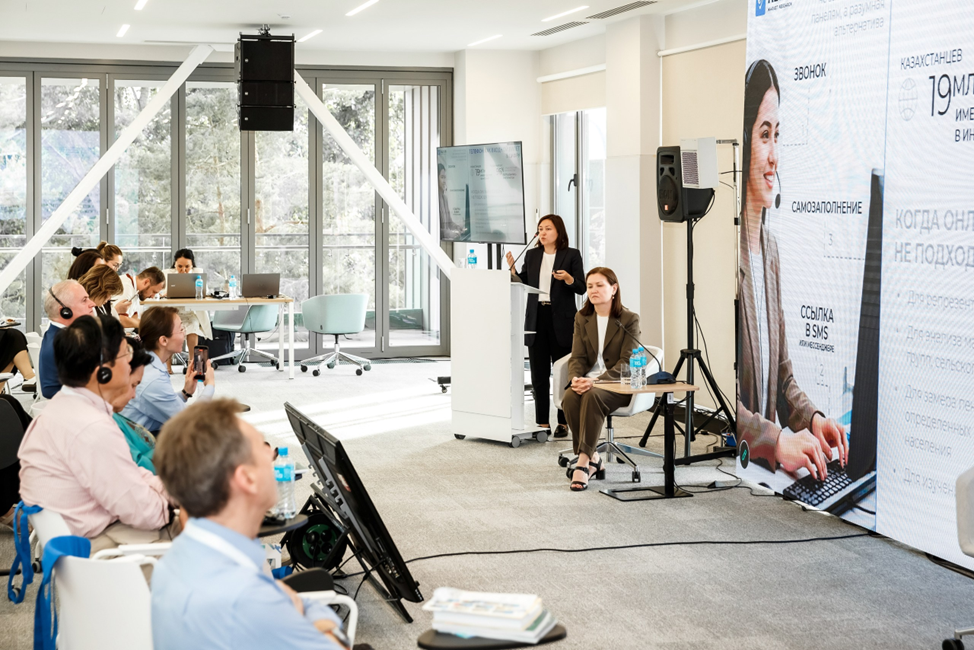
At the Sociological Forum at KISI, Natalia Ospanova, head of Alvin Market Research and president of KAPIOR, presented her perspective on how digitalization is changing data collection methods and why maintaining research quality is becoming a key challenge today.
Telephone surveys aren't dead. The old way of conducting them is.
When professional researchers talk about the future of the field, the important issues of maintaining data quality and reliability in the face of rapidly changing respondent behavior are actively discussed.
This topic was the focus of a report by Natalia Ospanova, head of the Alvin Market Research group, at the Sociological Forum "Digital Transformation of Sociological Research: Challenges and Trends of the 21st Century," organized by the Kazakhstan Institute for Strategic Studies under the President of the Republic of Kazakhstan (KISS), which took place on June 1-2, 2026.
According to the expert, Kazakhstan is currently experiencing a crisis in traditional data collection methods, which is affecting virtually the entire research industry.
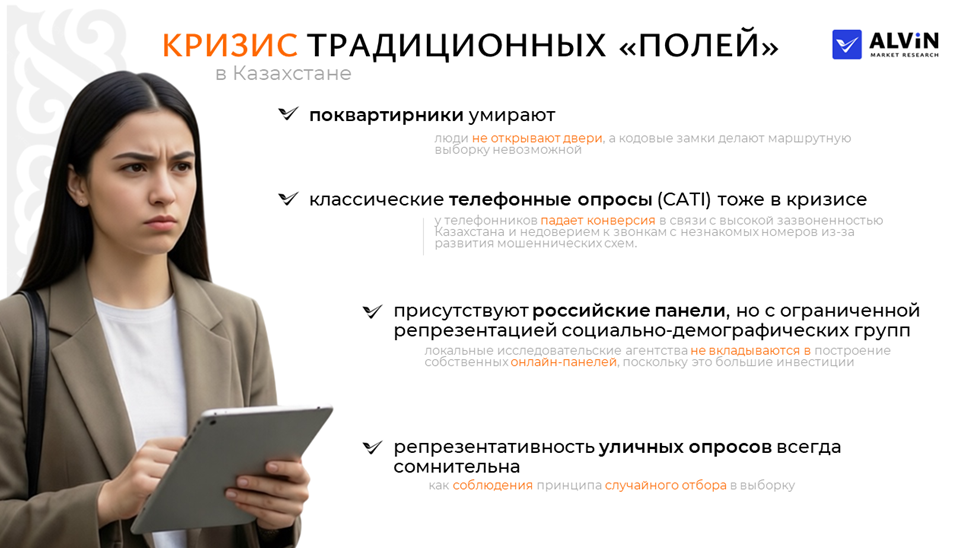
Door-to-door surveys are facing increasing restrictions: residents are increasingly reluctant to open their doors to strangers, while gated courtyards, intercoms, and access systems make traditional route-based sampling less effective.
Online surveys and street interviews also raise many questions in terms of sample representativeness.
Telephone research is under serious pressure due to the rise in telephone fraud and general public fatigue with calls from unknown numbers.
But this does not mean that the telephone as a research channel has lost its relevance.
The problem isn't the phone. It's the old technology.
One of the most revealing findings presented in the report was the performance data for telephone interviewers.
While in 2023, one operator collected an average of 1.8 questionnaires per hour, by 2026 this figure had dropped to 0.6 questionnaires. However, the use of a robotic assistant allowed productivity to increase to 1.5 questionnaires per hour, practically returning efficiency to its previous level.
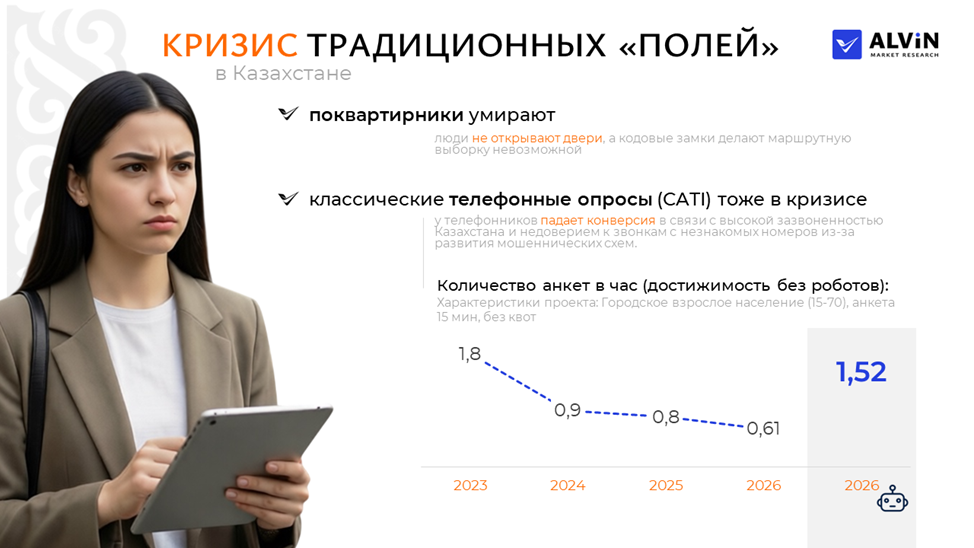
According to Natalia Ospanova, this points to an important point: the problem lies not in the telephone itself as a communication channel, but in how researchers organize the initial contact with the respondent.
Today, Kazakhstan is living in a digital anti-fraud environment. An unfamiliar number is increasingly perceived by people as a potential threat rather than a neutral call. Therefore, research projects are no longer competing with a reluctance to participate in surveys, but with people's natural desire to protect themselves from scammers.
Why the future lies not in robots, but in hybrid models
One of the main findings of the report is that digitalization does not mean abandoning people.
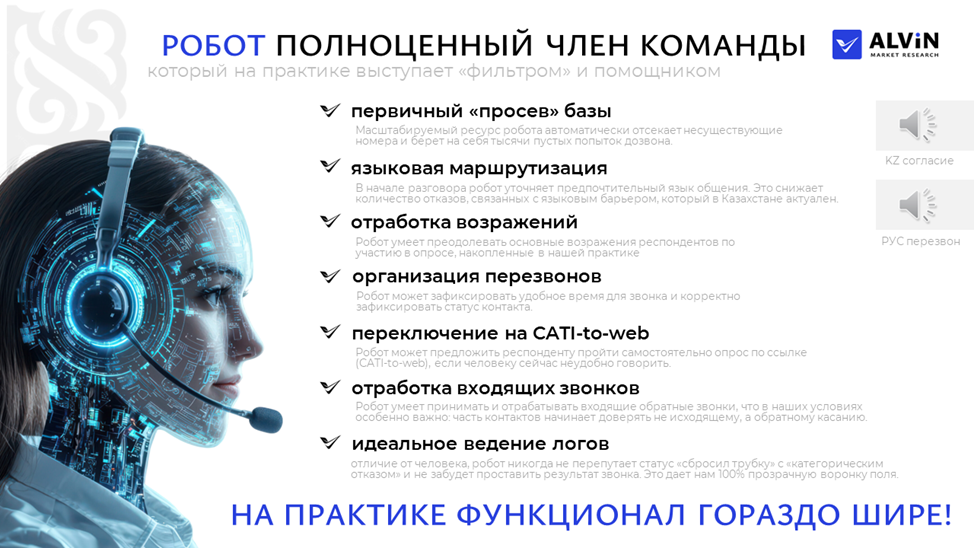
On the contrary, the most effective research models today are hybrid ones, where technology and the researcher combine their strengths.
In such a system, the robot performs routine work: processing calls, filtering outdated contacts, organizing follow-up calls, determining the language of communication, and routing the respondent. The operator, meanwhile, receives a pre-prepared contact and can focus on the interview itself.
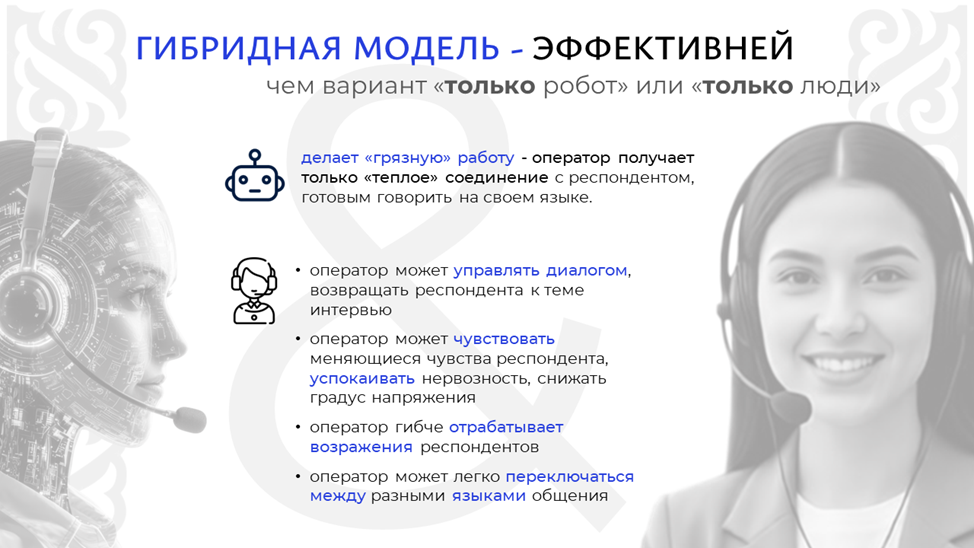
It is the person who remains the key element of research when it is necessary to sense the emotional state of the interlocutor, work with objections and maintain the quality of communication.
As Natalia Ospanova noted, the future of telephone research is not robots instead of people, but robots alongside people.
The New Currency of Research: Data Transparency
Another important trend is related to changing customer requirements.
Today, businesses and government agencies are no longer content with simply presenting numbers in a report. The ability to verify the quality of data and understand how it was collected is becoming increasingly important.
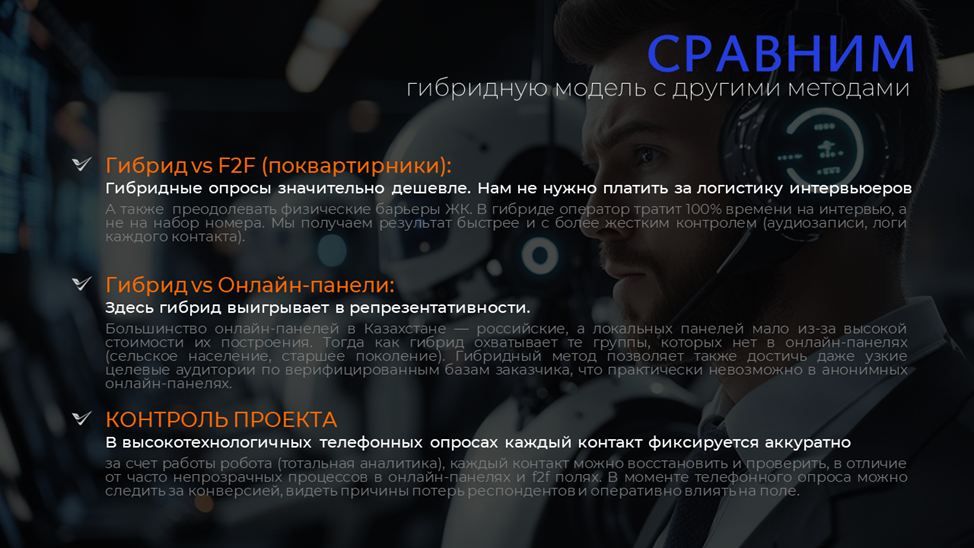
Hybrid models allow for recording every stage of the interview: call time, number of contact attempts, reasons for refusal at any stage of the interview, and conversation recordings. As a result, the data collection process becomes reconstructible and fully controllable.
In essence, digital technologies transform the field stage of research from a «black box» into a transparent, manageable process.
CATI-to-web: A new research model for digital Kazakhstan
The report paid special attention to the CATI-to-web model, which is actively developing.
Its logic is simple: a telephone is used to search for and verify a respondent, and the questionnaire itself is filled out by the person themselves via a link in an SMS or messenger.
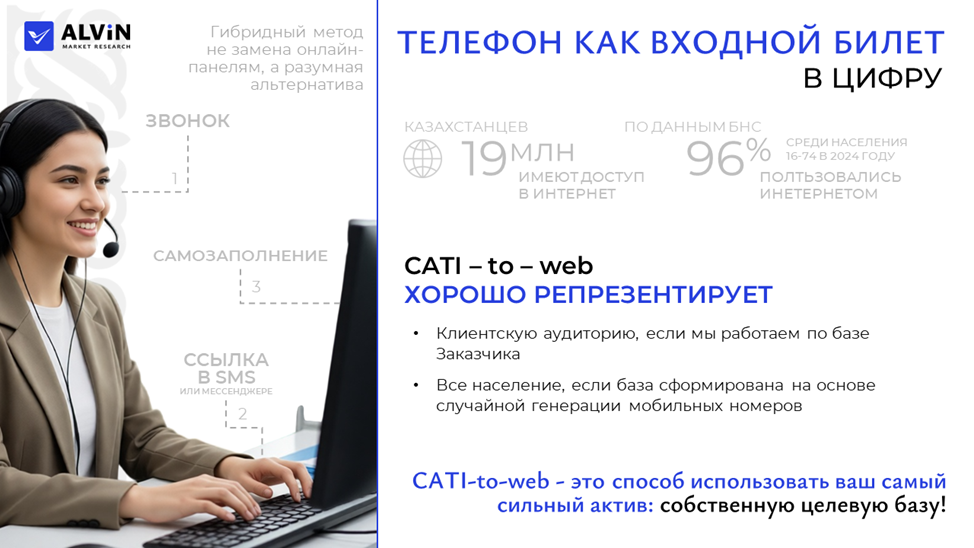
This model appears particularly promising for Kazakhstan. According to the Bureau of National Statistics, 991,000 households in the country use mobile phones, and over 961,000 people aged 16 to 74 use the internet.
This allows the phone to be used as a gateway to digital research, maintaining control over the quality of the recruit while gaining the benefits of online surveys.
This approach is particularly effective when working with client bases to recruit rare and narrow audiences, as well as when studying sensitive topics where it is important to minimize the influence of socially desirable responses.
What does this mean for the future of sociology in Kazakhstan?
The main conclusion of Natalia Ospanova's presentation is that the future of research is determined not by the struggle between methods, but by the ability of the research industry to adapt to the new digital reality.
Today, it's no longer enough to choose between a telephone survey, an online panel, or an in-person interview. It's far more important to create systems that ensure data quality, process transparency, and the ability to verify results.
The key asset of research companies is not the survey method itself, but the ability to manage the quality of contact with the respondent and control the reliability of the information received.
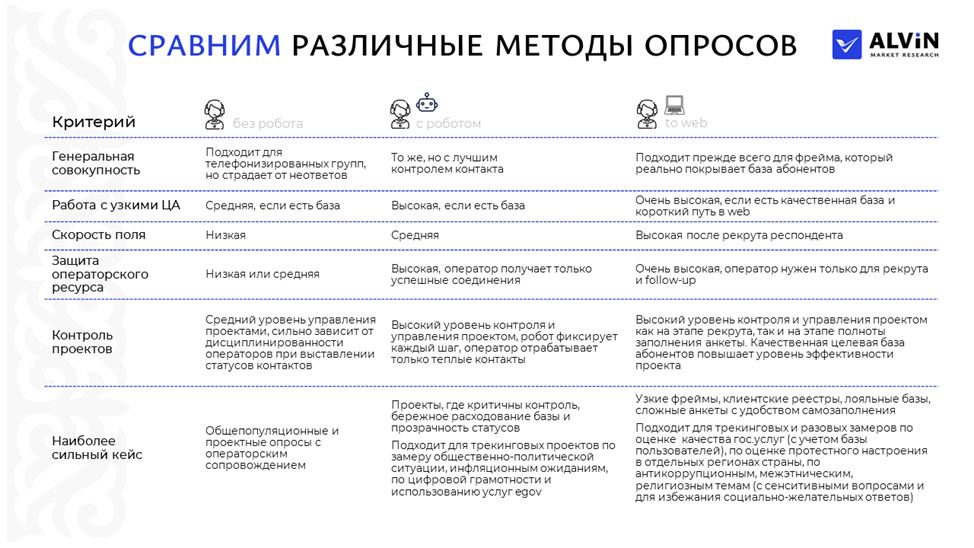
For businesses, government agencies, and the research community, this means a transition to a new model of working with data—one that is more technologically advanced, transparent, and evidence-based.
It is precisely these approaches that are shaping the future of sociological research in Kazakhstan today.
Reference
The report was presented by Natalia Ospanova, head of Alvin Market Research and president of KAPIOR, at the Sociological Forum «Digital Transformation of Sociological Research: Challenges and Trends of the 21st Century,» organized by the Kazakhstan Institute for Strategic Studies under the President of the Republic of Kazakhstan (KISS)..