The Business Life Cycle: What Marketing Research is Needed at Each Stage

Business doesn't develop in a straight line, but rather goes through several logical stages: formation, growth, maturity, decline, or transformation. Then, if the company restructures itself in time, reinvention occurs—that is, updating the product, brand, markets, and growth model. At each stage, a business faces different challenges: first, it needs to find a niche and test hypotheses, then scale up, then maintain market share and improve efficiency. Finally, it needs to recognize signs of decline, understand the reasons for performance decline, and find new directions.
Therefore, marketing research should not be viewed as a one-time service "before launch" or "when a problem has already arisen." In fact, it is a business lifecycle management tool that helps make decisions not based on intuition, but on data, market analysis, understanding of consumers, the competitive environment, and actual customer behavior.
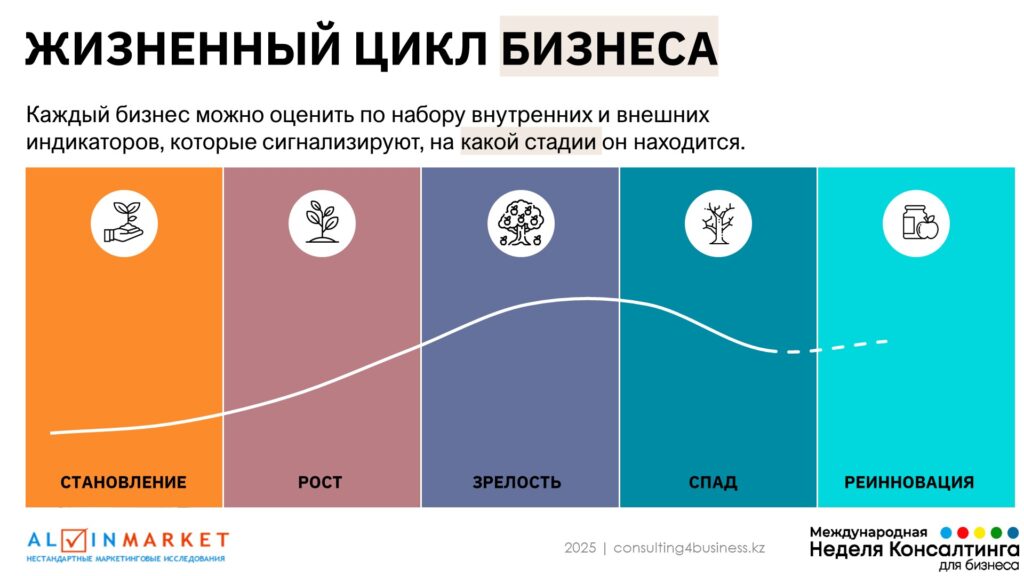
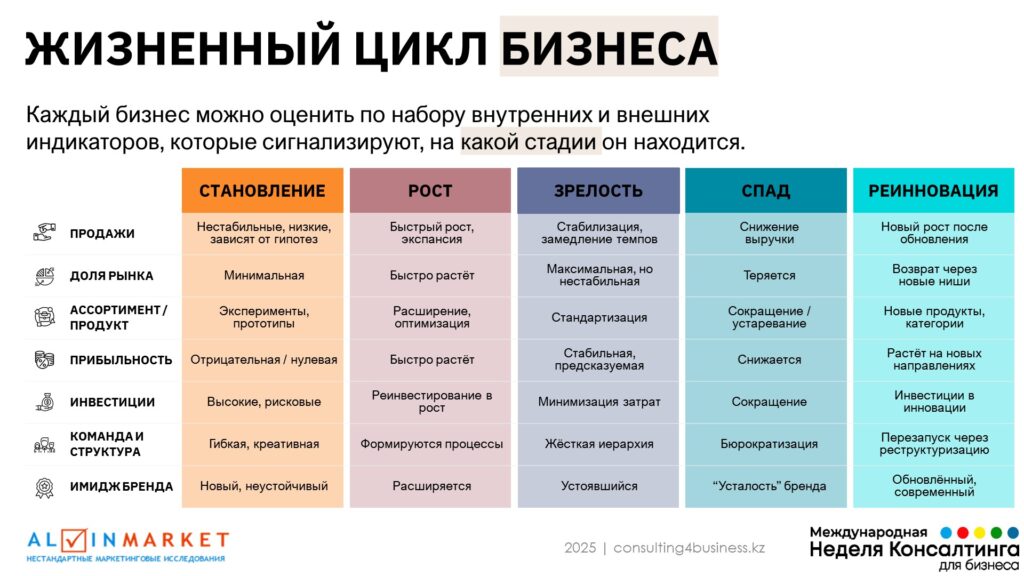
The stage of a business can be determined by a set of internal and external indicators: sales dynamics, market share, product range, profitability, investments, team structure, brand strength, customer behavior, and level of competition.
At the start, sales are unstable, the product is still changing frequently, the brand is unknown, and the team is flexible and experimental.
During the growth stage, demand rapidly increases, new processes emerge, product lines expand, the company actively invests in promotion, and begins to establish a strong presence in the audience's mind. At maturity, the business is already recognizable, market share is high, and profitability is more predictable. However, growth slows, competitors copy solutions, and customers become more demanding.
During the decline phase, revenue declines, the product becomes outdated, the brand loses its freshness, bureaucracy increases, and the risk of management panic arises. Reinnovation allows a company to overcome this situation through new products, new categories, new markets, and updated positioning.
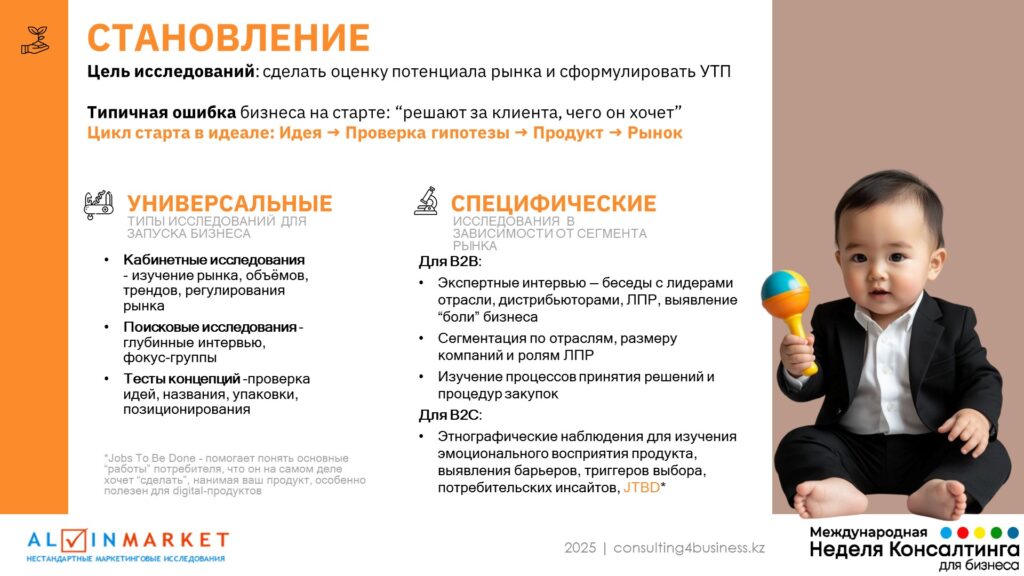
At the stage of formation, the main task of research - not allowing the business to decide for the client what he wants.
Entrepreneurs often make mistakes at the beginning: they think the idea is obvious, the market needs the product, the price is clear, and the audience will appreciate the benefits. But the market may respond differently. This requires desk research, volume and trend analysis, regulatory review, in-depth interviews, focus groups, concept testing, and testing of the name, packaging, and positioning.
For the corporate market, expert interviews with industry leaders, distributors, and decision-makers, analysis of purchasing procedures, and segmentation of companies by size, industry, and role are particularly important.
For the consumer market, observing real behavior, identifying barriers to choice, purchasing triggers, and consumer insights is useful. The higher the competition at the start, the more important it is to not only confirm interest in the idea, but also to find distinctive brand features, a vacant niche, and a real customer pain point that the product can address.
When a business transitions to growth, the focus is changing: now it's important not just to sell, but to scale without losing quality, loyalty, and brand meaning.
At this stage, the company's analytical culture is formed, regular data collection, customer satisfaction tracking, brand awareness and image measurement, audience segmentation, price sensitivity studies, and testing of advertising messages and promotion channels are introduced.
Growing businesses often face the temptation to expand in all directions at once, but marketing research helps them understand which segments are truly profitable, which sales channels work best, where customers get a strong experience, and where frustration and churn occur.
In the corporate segment, this stage involves analyzing tenders, assessing distribution channels, researching distributor and agent performance, and measuring customer satisfaction with service quality and response time. In the consumer segment, this involves researching consumption habits, attitudes toward the category, and the effectiveness of product displays, promotions, advertising, and visual solutions.

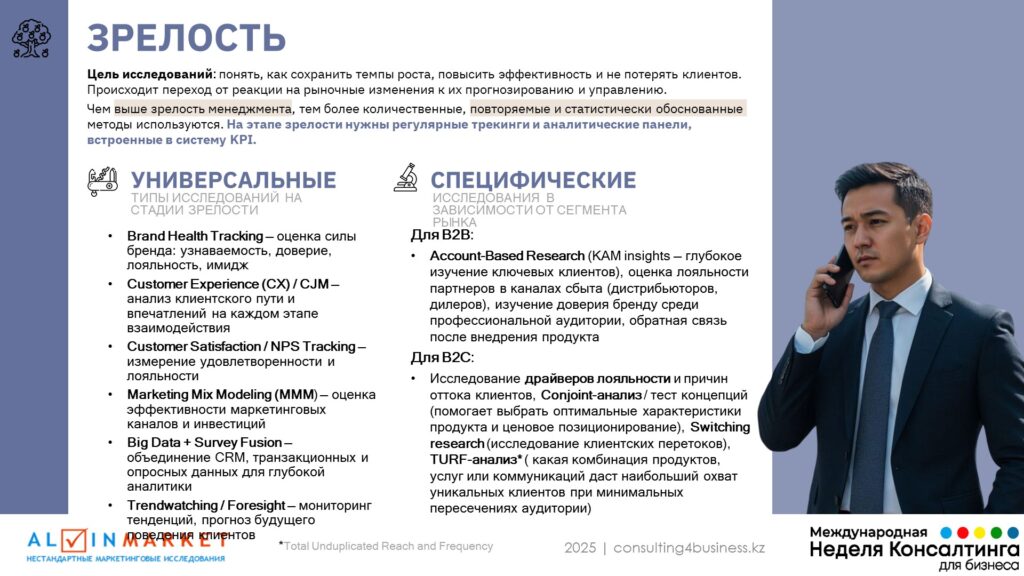
At the stage of maturity The company has already established itself in the market, but this is where the more subtle struggle begins: for efficiency, repeat purchases, trust, customer retention, and forecasting future demand.
Business can no longer be governed solely by management's perceptions; it requires regular, repeatable, statistically validated research integrated into a metrics system. At this stage, brand strength tracking, customer journey analysis, customer experience research, satisfaction and loyalty measurement, marketing investment effectiveness modeling, and the integration of data from customer databases, sales, surveys, and digital behavior are particularly important.
For a mature company, research becomes not a standalone project, but an early warning system: it reveals where trust is waning, which segment is starting to leave, which channels are delivering results, where service is creating losses, how brand perception is changing, and what competitor actions may impact future market share.
Decline or transformation — is the most sensitive stage, because businesses often see the symptoms but don't understand the causes. Sales decline, advertising is less effective, customers leave, the product seems familiar, the brand loses its emotional appeal, and internal disputes arise: is the problem price, competitors, the team, the market, or the offering itself.
At this point, research is especially important because it provides a cool, non-panic perspective. Alvin Market Research views decline not as the end, but as a diagnostic moment to understand what exactly has stopped working and where new growth opportunities may lie. This requires research into new positioning, analysis of lost customers, testing new directions and products, studying emotional brand associations, scenario planning, demand forecasting, and customer segmentation by value.
For the corporate market, exit interviews with clients and forecasting industry research are useful; for the consumer market, studying image, emotions, new meanings, cultural codes, and the appeal of new product lines is helpful.

Reinnovation begins thenand when a company doesn't simply correct an old model, but seeks growth anew: launching new products, developing new markets, testing new formats, updating service, packaging, communications, or the very logic of the offering.
This isn't chaotic creativity, but rather controlled innovation, where research reduces the risk of unsuccessful launches. This stage requires evaluating ideas, testing concepts for new products and services, co-developing solutions with clients and experts, trial launches with a limited audience, analyzing early users, testing prototypes, studying market reactions, and comparing with practices in other countries. In the corporate sector, co-creating solutions with key clients works well, especially where the product is complex and value is created jointly with the client.
In the consumer segment, testing of packaging, product, service, digital experience, and audience response is essential. Strong reinvention is built not on the question "what else can we come up with?" but on the question "what new customer need can we meet better than the market currently does?".

To summarize, At every stage of the business life cycle, research is needed, but their role is changing. At the start, they help choose the right niche, audience, and value proposition; during the growth phase, they help scale and strengthen the brand; during maturity, they help manage performance and retain customers; during decline, they help understand the causes of performance declines and find new growth opportunities; and during the reinvention phase, they help test new ideas before making major investments.
The more competition there is and the faster the market changes, the more important it is to conduct regular research, as data quickly becomes outdated, and decisions made out of inertia can cost a business market share, profits, and customer trust.
Alvin Market Research helps businesses see not just isolated symptoms, but the whole picture: where the company stands now, how the market is changing, what's happening with consumers, which competitors are gaining strength, which products are losing relevance, and which areas could become the foundation for new growth. A sustainable business begins not with a hunch, but with a precise understanding of reality.