From Like to Purchase: Everything You Need to Know About E-Commerce in Uzbekistan

Online retail in Uzbekistan is growing rapidly and has already become an integral part of urban life. Alvin Market's research traced the customer journey—from the initial thought of purchasing to placing an order and interacting with the seller. We present live data and key insights about which consumer patterns have already taken hold and which are just emerging.
This comprehensive approach helps businesses develop strategies in a context where online commerce is becoming a key part of Uzbekistan's economy and setting new rules for retail and marketplaces.
This material is based on fresh data from the May 2025 survey and presented by Natalia Ospanova, President of the Kazakhstan Association of Professional Public Opinion and Market Researchers (KAPIOR) and Head of the Alvin Market group of research companies.
The survey was conducted online among urban residents over 18 years of age, allowing us to reach the most active, savvy, and digitally savvy audience—those who regularly use the internet and set the tone for the entire market. All findings are extrapolated specifically to this internet-active group, which is more likely than others to be the first users of new services and influence the behavior of others. A total of 500 people participated in the study, and fieldwork was conducted on May 6 and 7, 2025, ensuring the data is highly relevant and current.
Now let's move on to the main point: what the online purchasing process looks like today from the buyer's perspective. We've broken this process down in detail, step by step. The research results show which touchpoints businesses should invest in to avoid losing customers along the way.
Online shopping
Let's start with a basic, but very important fact: 84% of Uzbekistan's internet users have made online purchases in the last 12 months.
This suggests that the internet audience in Uzbekistan is already actively involved in online shopping, and the practice of online shopping among Uzbeks has already been established.
This means that it's time for businesses—especially in the e-commerce segment—to move from theory to practical solutions, based on real data on consumer behavior.
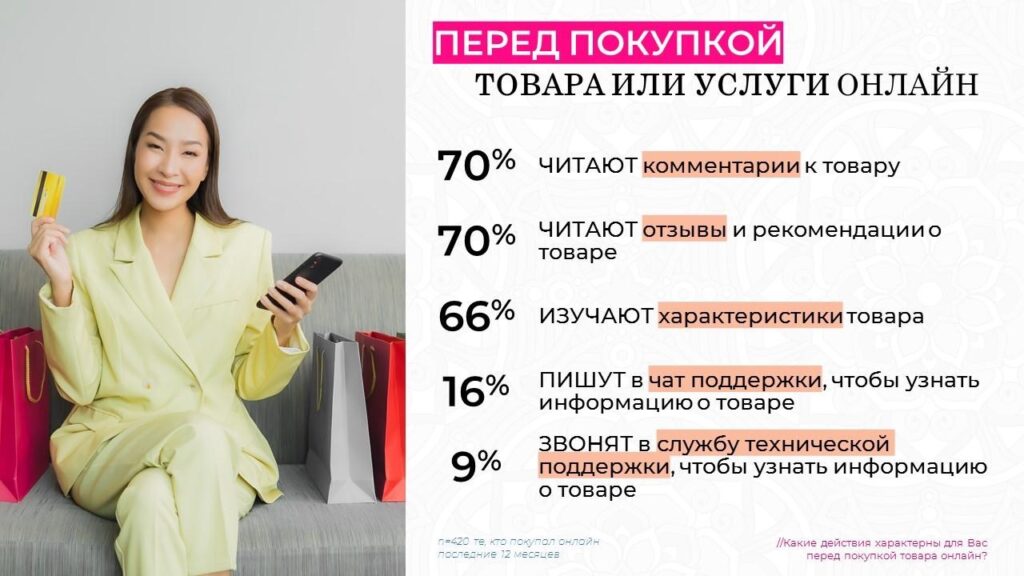
Before purchasing a product or service online, most users actively collect information.
70% of % users read comments, the same number read reviews and recommendations, and two-thirds study product specifications. This is especially important in complex categories where prices are higher or technical nuances are involved: the more complex the choice, the more involved the user is in the research process.
16 % customers contact support chat, and 9 % customers even call technical support. Direct communication with the seller remains popular, despite all the key information already being provided on the product page.
Therefore, it's important to provide users with detailed specifications, manage reviews, and maintain an open line of communication. Otherwise, there's a risk that customers will switch to a competitor—one who's more accessible and responds faster to inquiries.
Where do they look for opinions and how do they communicate?
Only 5 % users are not interested in other people's reviews at all, while 95 % are looking for other people's experiences.
It's especially interesting where exactly they do this. Video reviews on YouTube and other video hosting sites top the list. This means that visual content with real emotions is more trustworthy than text alone.
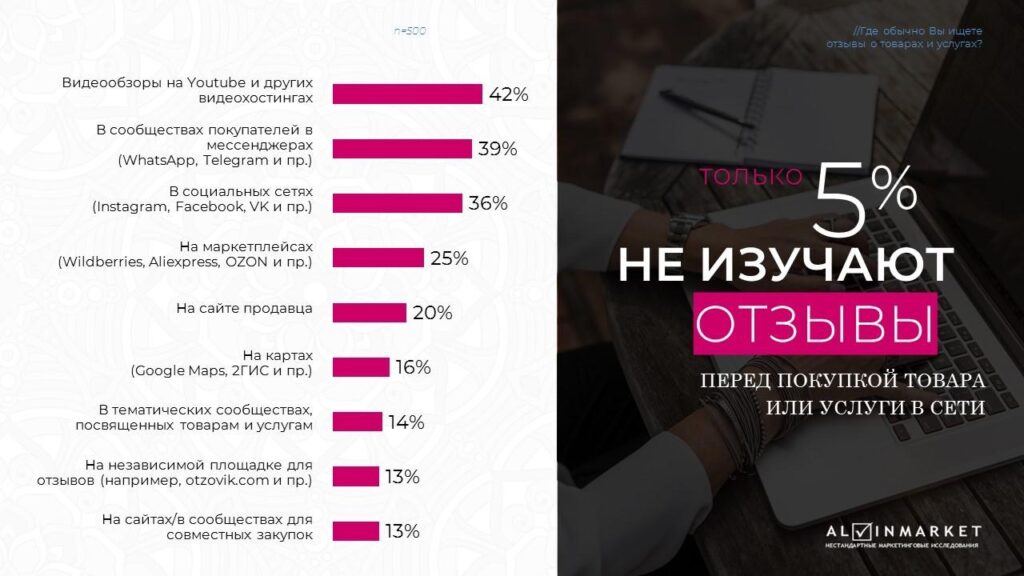
Next come messengers and consumer communities, where people communicate directly and trust each other.
And, of course, social networks – Instagram, Facebook and other platforms where you can quickly scroll, read and watch.
For brands and marketplaces, this is an important signal: a content-based approach and working with real reviews in video format are a true must-have today.
Live communication as the key to trust
When a user decides to contact a seller, they expect a live dialogue, not an impersonal feedback form.
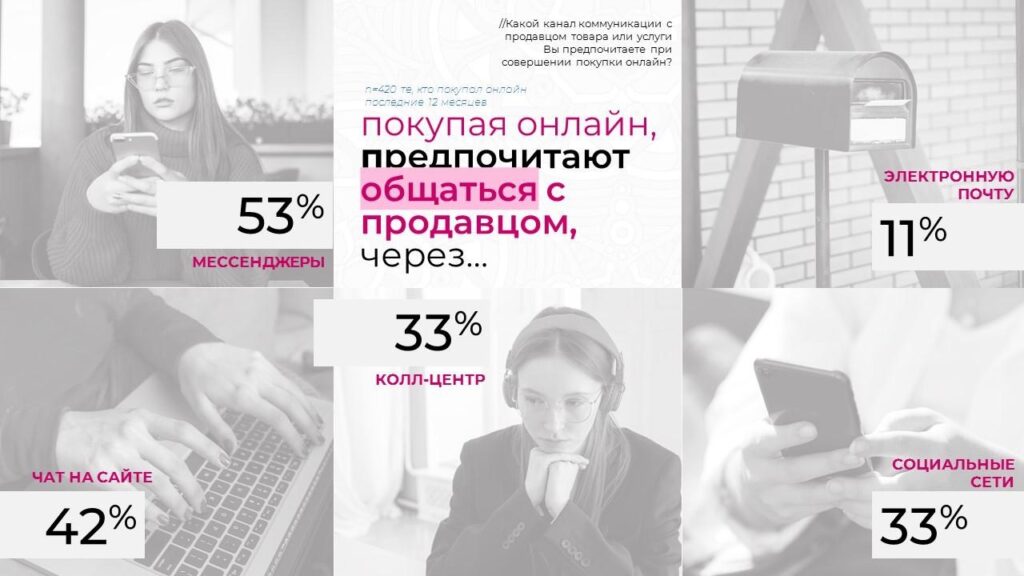
The results of the study clearly confirm this.
Messengers (Telegram, WhatsApp, and others) top the list, with 53% of respondents citing them as their preferred method. People want to communicate "like in real life"—quickly, conveniently, and with a human response.
The site's chat is also popular - 42 %, especially if it doesn't look "bot-like" and is actually helpful.
Only 11% of people choose email, which clearly puts it outside the category of primary communication channels.
It is noteworthy that a third of respondents are still willing to call a call center or contact them via social media if they need to clarify details or resolve a problem.
All this data confirms that a company's digital presence is more than just a website and a "buy" button, but a fully-fledged communications environment where speed, human touch, and accessibility are crucial.
What motivates people to buy?
According to the survey results, free delivery is the clear winner in terms of appeal, valued by 45% of respondents. This confirms a general trend: the absence of additional delivery fees is becoming a key factor in choosing a marketplace, often more important than even the speed of order delivery.
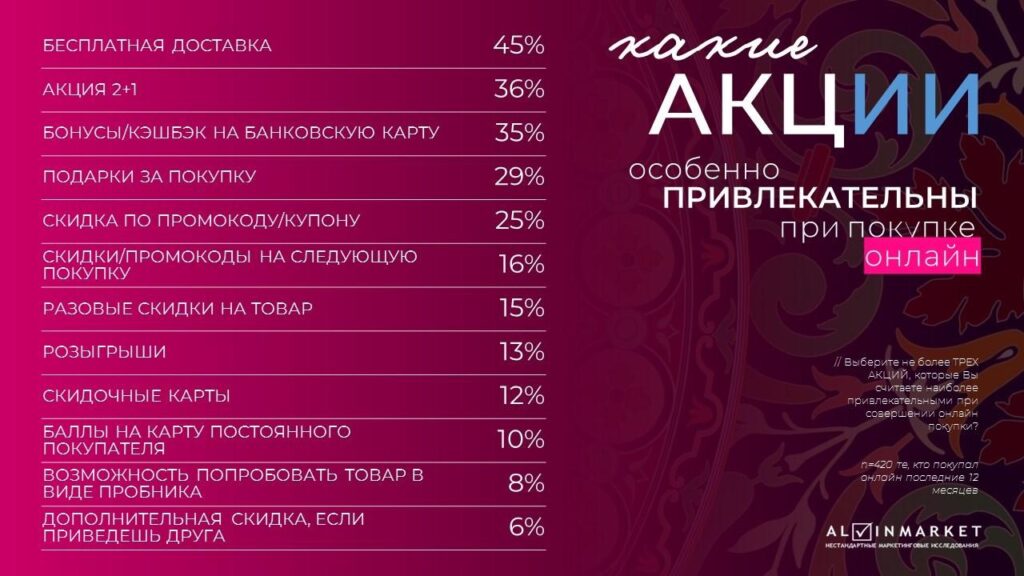
Surprisingly, classic discounts fell at the bottom of the list: one-time offers, promo codes, and discount cards. This demonstrates that shoppers are becoming resistant to traditional "basic" promotions and are increasingly responding only to specific, tangible benefits here and now.
For marketplaces and brands, this sends a clear signal: convenient logistics, "buy more, pay less" promotions, and cashback, which provide a real sense of savings and increase customer loyalty, are becoming decisive factors in product selection.
How often do people make online purchases?
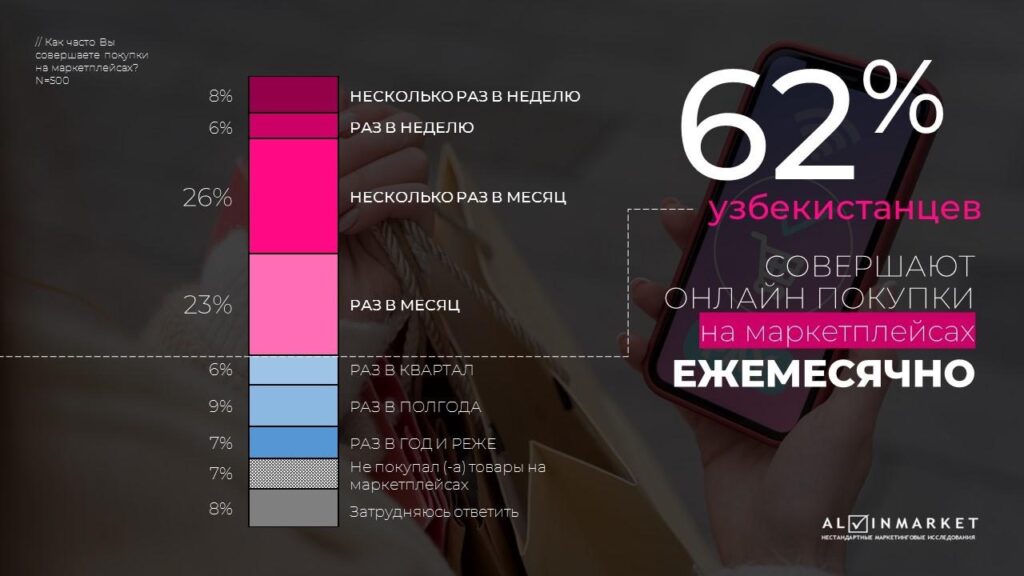
The results show that two-thirds of the country's online audience can already be considered regular online shoppers, not casual users. For them, online shopping is a habit ingrained in their everyday lives.
The remaining audience is currently making purchases less frequently or not using marketplaces at all, but this is more a reserve for future growth than a final rejection of digital shopping.
Marketplace leaders
Which online shopping platforms are most popular in Uzbekistan? We examined the marketplaces where residents most frequently order clothing, electronics, cosmetics, and other goods, and also analyzed food and grocery delivery services to determine which are currently the top sellers.
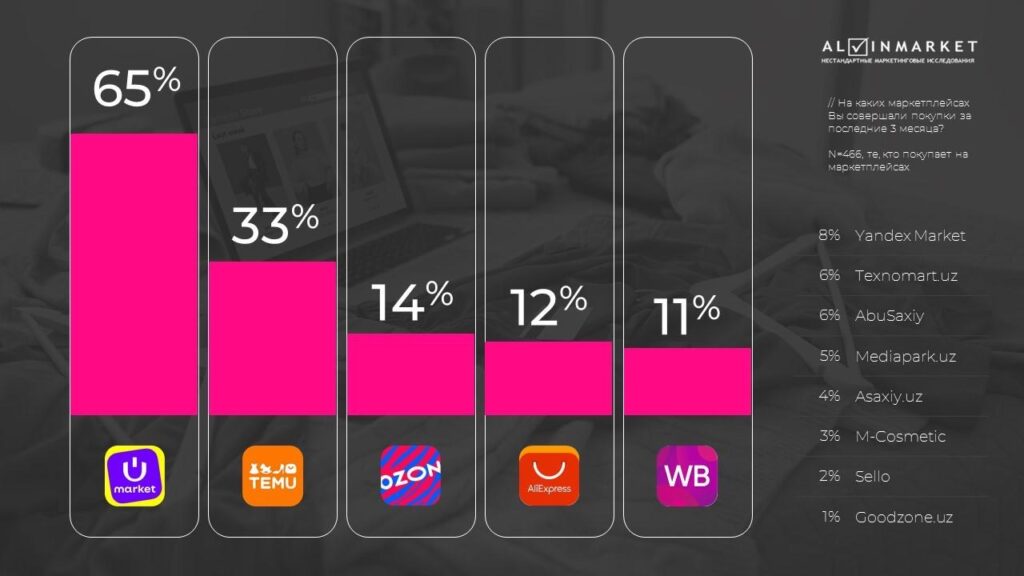
A clear leader has emerged in Uzbekistan's online retail market: Uzum Market, cited by 65,000 respondents. This is almost double that of its closest competitor.
Temu came in second with a score of 33 %. This result demonstrates that even foreign newcomers with active marketing support can quickly capture a significant market share.
Russian marketplaces occupy more modest positions: OZON - 14 %, Wildberries - 11 %.
This balance of power highlights that key factors in consumer choice are not only product selection and price, but also convenience, trust, delivery speed, and proximity to the user—in the broadest sense of the word.
What do people buy on marketplaces?
Let's take a look at which products make up the bulk of online sales today.
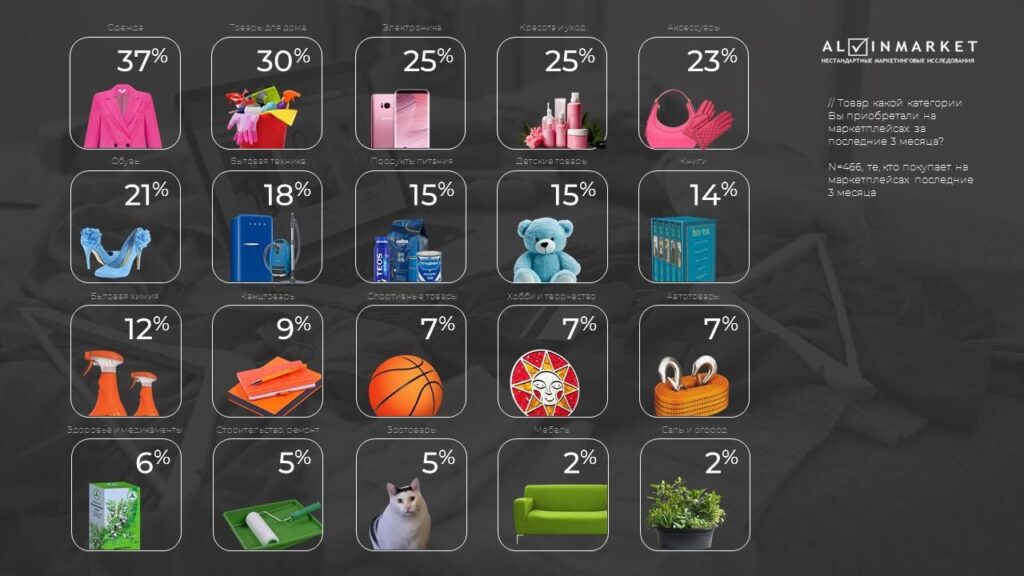
The clear leaders are clothing (37 %), accessories (23 %), and footwear (21 %). In fact, fashion and style remain the main drivers of online retail: these categories lend themselves well to visual content, easily fit into "2+1" promotions, and are frequently repurchased.
The second most popular items are household goods (30 %) and beauty and personal care products (25 %).
Third place goes to electronics (25%) and household appliances (18%). These purchases are more rational, but also demonstrate stable and high demand.
Leaders in grocery delivery services

Another important insight: online food and grocery delivery has already become a daily practice for many residents of Uzbekistan. Over the past three months, 65% of respondents ordered groceries online.
For brands, this means a new level of communication with customers: now the product must be present not only on the supermarket shelf, but also in the recommended lists of apps and delivery services, where the real choice takes place.
Looking at the food and grocery delivery services most frequently used by residents of Uzbekistan, a familiar trend emerges. The local platform Uzum Tezkor leads the way, with 44 %.

Yandex Food is in second place with a score of 35 %. This is an impressive share for an international player, but it still lags behind a local service that is closer to consumers and better tailored to their habits and expectations.
Conclusion and findings
Alvin Market's research convincingly demonstrated that online shopping in Uzbekistan has ceased to be a one-time occurrence and has become a daily habit. Most internet users now place orders regularly, and their expectations for service quality are growing with experience.