«The Age of Sloppers: How Delegating Choice to Artificial Intelligence is Changing Consumer Behavior and Our Brains
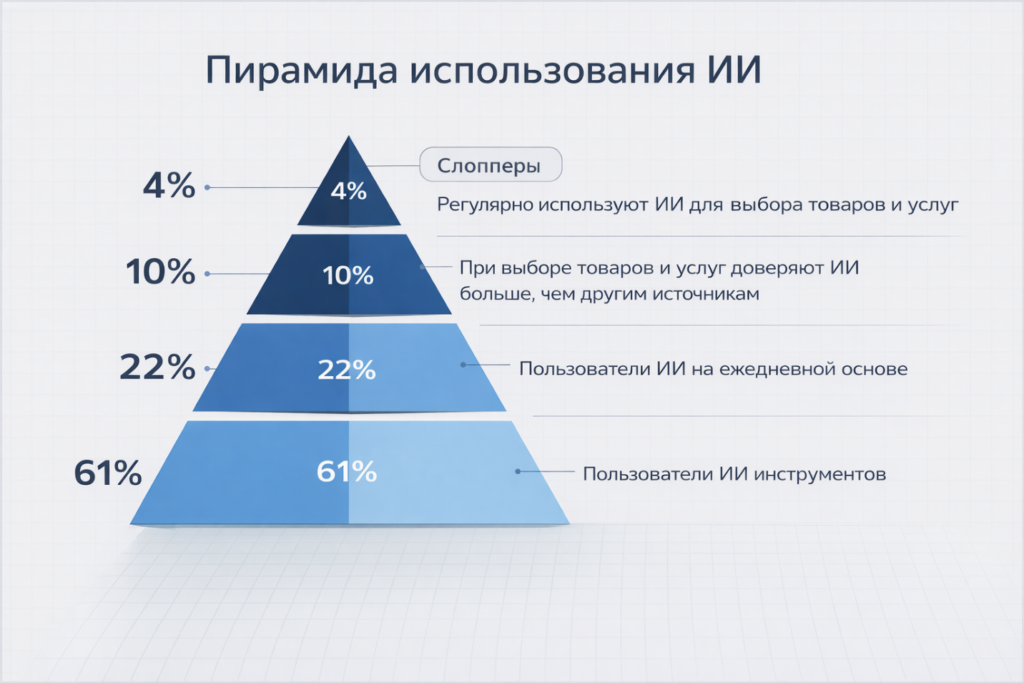
In a world oversaturated with information, a new type of consumer is emerging. Researchers call them «"sloppers"» (from English). slop — unstructured mass, "mess"). These are people who prefer not to waste cognitive resources comparing hundreds of options, but delegate everyday decision-making to artificial intelligence.
Cognitive outsourcing: adaptation or degradation?
The traditional consumer behavior model of "search for a way to satisfy a need, compare alternatives, and choose" is gradually becoming a thing of the past. Modern people are in a state of constant "choice overload," where the need to filter through hundreds of products and services becomes an exhausting chore. AI, in this scenario, serves as the perfect filter for chaos.
However, experts divide "sloppers" into two camps, which raises questions about the future of human cognitive abilities:
- Conscious Sloppers They use AI as a high-performance assistant, verifying results. For them, this is a redistribution of cognitive load: freeing the brain from mundane details in favor of strategic tasks.
- Passive Sloppers tend to trust the algorithm without filtering.
It's the second type that raises concerns among futurologists and psychologists. There's a real risk of declining critical thinking skills and "decision laziness" when complex decision-making processes are simplified to a single click on a machine recommendation. If thinking is replaced by an algorithm, people gradually lose the ability to independently analyze things, and we could encounter a phenomenon that could be loosely termed "cognitive outsourcing addiction.".
We decided to investigate the extent to which this trend has affected the Kazakh consumer. In January 2026, Alvin Market conducted a telephone survey of 500 Kazakhs (aged 16–64, urban and rural). The survey results show that the proportion of slopers is small, amounting to approximately 41% of consumers. However, this segment is an important indicator of tectonic shifts in consumer behavior.
Futurology: What will choice look like in the future?
If today we choose a product by looking at a shelf or a screen, then in the future, where humanity completely delegates choice to algorithms, the very concept of a "brand" in its current form may disappear.
From a futurological perspective, the market may transform into an Algorithm to Algorithm (A2A) model:
- Battle for parameters: Consumers will no longer make direct choices. The choice will occur not in the human mind, but within code. Brands will compete to meet technical criteria that the AI assistant prioritizes for each user (for example, the ideal combination of price, delivery speed, and product composition).
- The Death of Visual Marketing: Today, brands compete for human attention. Tomorrow, they will compete for algorithmic recommendations, meaning the primary goal will be for AI to "like" a brand. Why invest in packaging design or expensive video advertising if a neural network makes the purchase decision in the background? Emotional attachment to a brand may give way to an "algorithmic trust index.".
- The disappearance of spontaneous purchases: AI that optimizes budgets and needs could eliminate the impulsive factor, which would deal a blow to entire checkout-oriented industries.
With the development of AI, humanity faces not so much a technological challenge as a philosophical one: where is the line between convenience and the loss of autonomy?
A study conducted by Alvin Market shows that society has yet to form a clear opinion on AI. Only 22% view its impact positively, while the majority are uncertain or ambivalent.
▪️ 22% — consider the impact to be rather positive
▪️ 14% - rather negative
▪️ 40% — sees both pros and cons
▪️ 24% — they don't yet understand how to evaluate
The main question of the future: will AI become a tool that enhances our capabilities, or will it become a substitute for the very process of thinking? Today's 4% "sloppers" are the first harbingers of a world where the most important choice we face is the choice of what we are still willing to make ourselves, without the help of neural networks.