Dream Jobs for Kazakhstanis: How Employer Selection Logic is Changing
The beginning of the year traditionally becomes a time for career decisions. Employees consider changing jobs, and employers consider how to attract and retain people in the face of increasing competition for talent. To understand what an employer's offer should be in 2026, the company Alvin Market conducted a study among urban residents of Kazakhstan. The survey was conducted using a hybrid method (phone and online interviews), with a sample size of 675 respondents.
The study's findings indicate that Kazakhstan's workforce is mobile, and employee expectations are becoming increasingly differentiated.
The level of labor mobility in Kazakhstan
According to the study, 32% respondents have changed jobs in the past three years. We observe moderately high labor mobility—a labor market condition in which:
- employees are not tied to one employer for a long period of time,
- changing jobs is seen as an acceptable and natural development strategy,
- The employer market is changing to a job seeker market, and the process of retaining personnel is becoming a crucial management task.
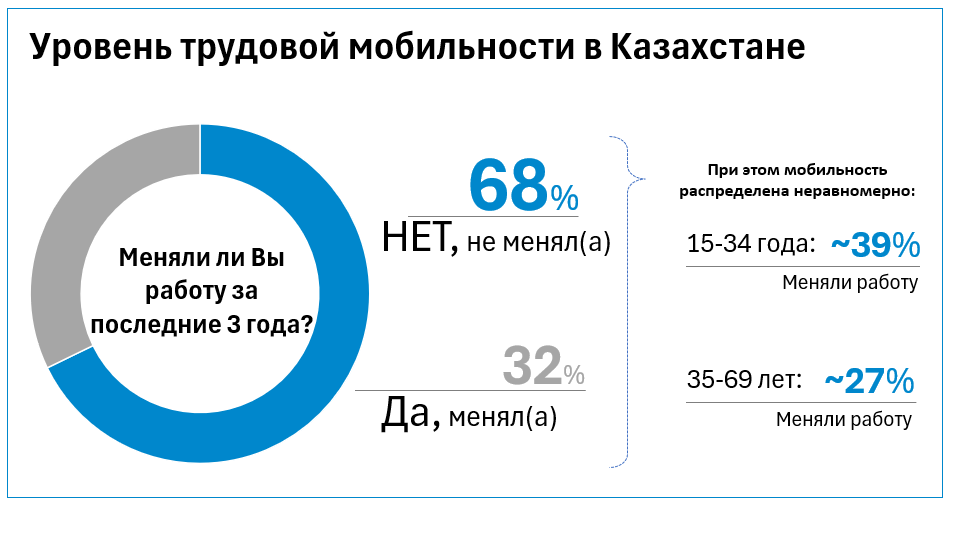
Younger employees demonstrate a greater willingness to change and are less committed to a single employer, while older employees are focused on stability and maintaining their current position. For HR, this means that turnover risks are concentrated primarily among younger age cohorts. One-size-fits-all retention programs are ineffective.
When employees leave not because of salary
Amid growing competition for talent, employers are increasingly faced with a paradox: higher salaries and expanded standard benefits are not leading to the expected reduction in turnover. This points to a deeper transformation in employee motivation—from a transactional model ("working for money") to a model of conscious employer choice.
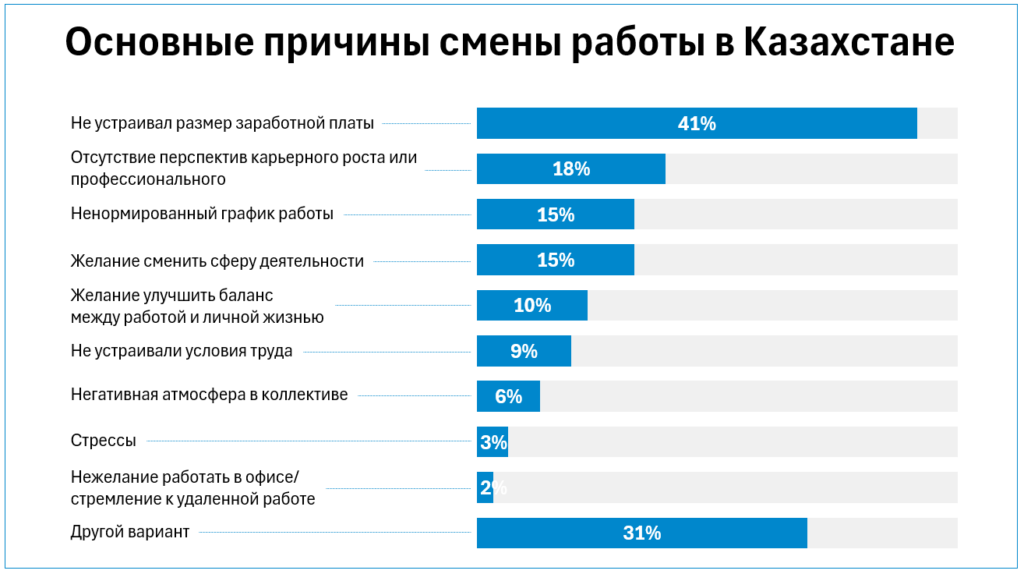
According to the survey results, the main reason for changing employers at the employee's initiative remains the financial factor: 41% respondents indicated that they were dissatisfied with the salary level. However, the data shows that salary is more likely to be the deciding factor. trigger, whereas in 59% cases leaving the company was due to other reasons.
In addition to salary, significant reasons for leaving include:
- lack of career prospects;
- inappropriate work schedule and format;
- desire to change the field of activity;
- the desire to improve work-life balance.
In other words, salary triggers the decision to leave, but it's reinforced by a host of non-material factors: an unstable, inflexible, and emotionally draining work environment. With equal salaries, employees increasingly opt for a healthy team environment, a comfortable work environment, and a fair management approach.
Why Companies Have a Hard Time Understanding Why People Leave
One of the key management risks is the lack of systematic knowledge about why employees leave. Most companies either don't conduct exit interviews at all or use formal questionnaires without analytical processing.
Meanwhile, it is the departing employees:
- most honest in their assessments,
- are best able to see the discrepancies between the employer's promises and reality,
- are the first to shape the external reputational background of the employer.
Exit interviews should be considered as a management diagnostic tool that allows identifying bottlenecks in motivational and management practices.
Social package as an element of retention strategy
The structure of the total remuneration paid to employees is of particular importance. 75% of respondents consider the presence of a social package critically important or desirable.
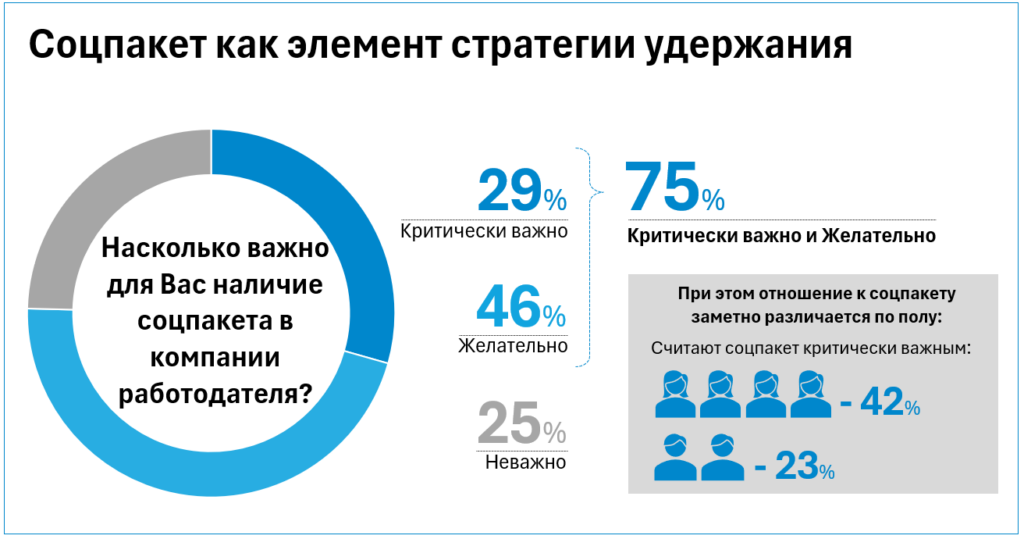
This reflects different motivational logics: for women, the social package is an element of security and long-term stability, while for men it is more of an additional, but not key, bonus.
The social package structure is dominated by health insurance, followed by tuition fees and sports compensation.
The social package structure is dominated by health insurance, followed by tuition fees and sports compensation.
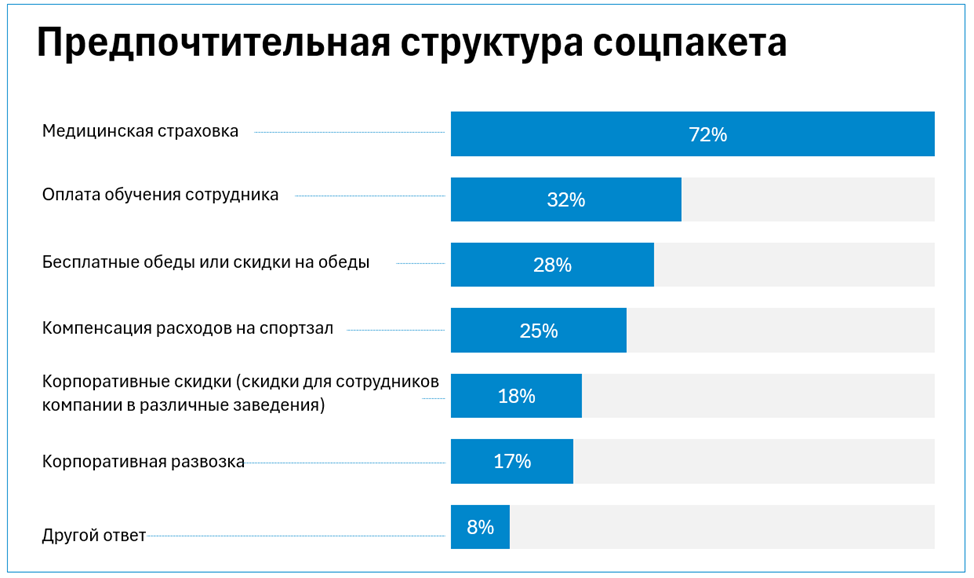
Women are statistically more likely to expect from their employer tuition fees, and the young audience - wellness benefits, including sports.
Thus, it is advisable to consider the social package as modular system, enhancing the retention of specific segments.
Working Format: Hybrid Has Become the New Norm
Despite the debate around remote work, most Kazakhstanis prefer a hybrid format, with remote work remaining a niche option.
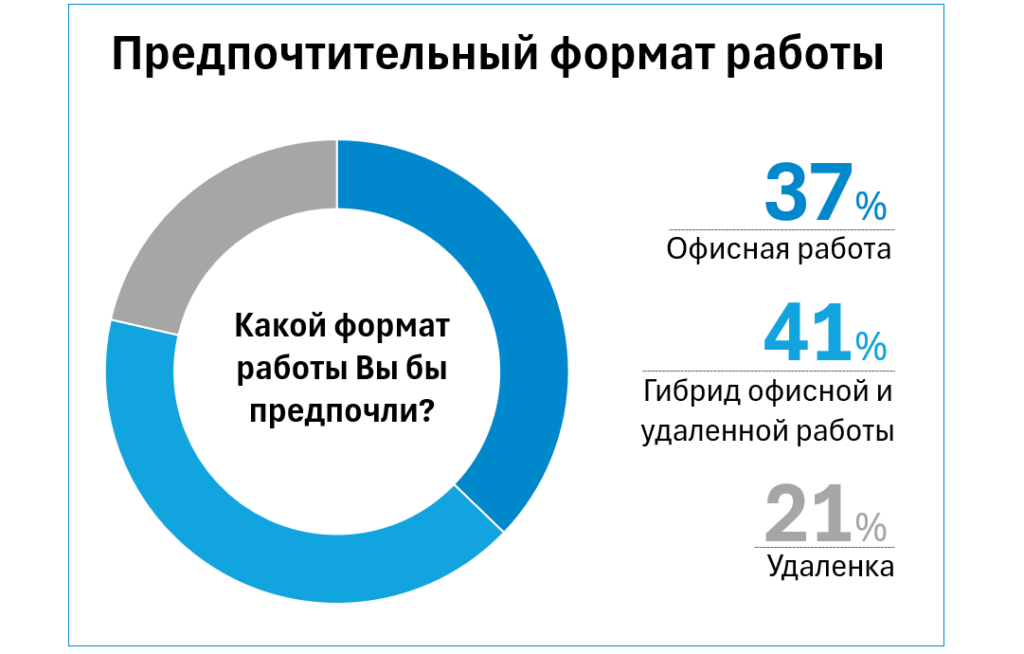
Preferences for work format do not depend on either gender or age.
We are seeing the hybrid format becoming the market norm. The absence of a hybrid format reduces an employer's attractiveness, but its presence alone does not create a competitive advantage.
What makes a job truly attractive?
Regular eNPS measurements to assess employees' willingness to recommend their employer are becoming a rule of good business practice. This is an important indicator that allows for early detection of warning signs. However, this metric alone is insufficient to understand the causes of job satisfaction or dissatisfaction.
The study shows that, in addition to salary, employees identify several key intangible factors that influence employer attractiveness:
- understanding and respectful leadership;
- a pleasant atmosphere in the team;
- career growth;
- stability and confidence in the future;
- flexibility of schedule.
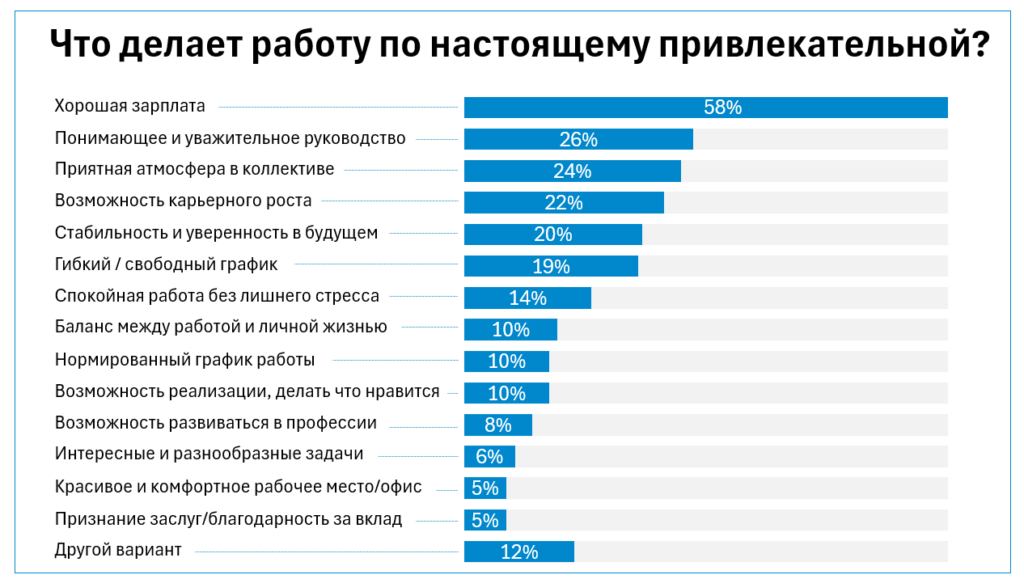
This is where the most important part of the study becomes apparent: different employee segments are guided by different motivational logics. Employers that use a single employee value proposition for all segments systematically lose out on recruitment and retention. The most sustainable HR strategies rely on differentiating the employee value proposition while maintaining the core value proposition.
EVP matrix: what is important for each segment
| Segment | What's really important to them | EVP-proposition (meaning) | What to emphasize in communications |
| All employees (base) | Decent salary, hybrid format, basic benefits package | «"Fair conditions and a modern work format"» | Competitive pay, hybrid, transparent rules |
| Women | Respectful management, benefits package, development | «"A job that values people and invests in growth"» | Care, support, training, humane management |
| Men | Flexibility, autonomy, time control | «"Freedom in work and focus on results"» | Flexible schedule, trust, minimal micromanagement |
| 15–34 years old | Career growth, development, dynamics, flexibility | «"A place to grow and try new things"» | Career tracks, training, projects, growth rate |
| 35–69 years old | Stability, calm work, confidence | «"Reliable work with a future-proof foundation"» | Company stability, benefits package, predictability |
| Women 15–34 | Growth + support + respect | «"Grow in a supportive environment"» | Mentoring, training, respectful style |
| Women 35–69 | Security, calm, care | «"Stress-free work with real support"» | Health insurance, stability, and employee care |
| Men 15–34 | Freedom + growth + interest | «"Grow fast, work flexibly"» | Projects, flexible schedule, career dynamics |
| Men 35–69 | Autonomy + stability | «"Experience is valued, results are trusted"» | Trust, lack of pressure and total control, stability |
Thus, employee motivation is determined not only by salary, but also by their stage of life and expectations from work.
Employer branding as an object of management
The study demonstrates that one of the important intangible factors influencing a company's attractiveness is the management style and the employer brand in general.
In a highly mobile environment, the employer brand is no longer static. It is formed:
- in professional communities,
- in digital channels,
- through personal stories of former employees.
This makes it necessary to constantly monitor the employer’s reputation, including:
- analysis of reviews and mentions,
- regular employee surveys,
- tracking the reasons for refusals and dismissals,
- comparison of candidates' expectations and actual experience.
Monitoring the health of an employer brand is becoming an important component of HR strategy. A strong employer brand becomes a source of competitive advantage not only in recruitment but also in retention.
Employer Brand Management Framework
Transitioning from individual insights to an employer brand management framework allows us to build a system of indicators and link expectations, experience, loyalty, and turnover into a single, manageable model.
| Indicator | What does it measure? | Stage of the employer branding cycle | The main question | How is it calculated? |
| eNPS (Employee Net Promoter Score) | Willingness to recommend the employer | Loyalty/Reputation | «"Would you recommend us?"» | % promoters (9-10) − % critics (0-6) |
| Engagement Index | Employee engagement and energy | Daily experience | «"Do I want to work here and try hard?"» | Average score on the engagement scale (1–5 or 0–10 scale) |
| Trust Index | Trust in leadership and fairness | The basis of loyalty | «"Can you trust the company?"» | Average value for the trust block (management, decisions, honesty) |
| Attrition Intent | Intention to resign | Risk of leaving (forecast) | «"Am I planning to leave?"» | % answers "most likely yes" + "yes"« |
| Candidate Experience Index | Candidate experience | External contact | «"What is it like to be a candidate?"» | Average Employment Experience Index (Satisfaction Scale) |
| Employer Reputation Index | External image of the employer | External reputation | «"How does the market perceive us?"» | Weighted Index of Reviews, Sentiment, and Mentions |
| EVP Fit Index | Meeting EVP Expectations | Market expectations | «"Does the EVP match expectations?"» | The proportion of matches "important" × "available at the employer"« |
| Stress Index | Emotional stress | Risk of burnout | «"How hard is it for me to work?"» | Average stress/burnout scale index |
| Manager Effectiveness Index | Quality of management | Point of influence | «"How does my boss work?"» | Average manager rating index |
The study clearly demonstrates that employers who win are not those who offer "more," but those who focus their communications with the workforce correctly. Companies that continue to use one-size-fits-all approaches face increased turnover and declining hiring effectiveness. Those who build their EVPs based on segmented data and have a clear system for assessing the health of their employer brand gain a sustainable competitive advantage in the war for talent.