How Artificial Intelligence is Destroying Traditional Brand Loyalty
Consumer loyalty has long been considered one of a brand's most enduring assets. For years, companies have invested in brand recognition, emotional connection, repeat purchases, and the consumer's habit of choosing "their own." But today, this model is rapidly changing. The main driver of this change is no longer advertising or price competition, but artificial intelligence.
A study by Alvin Market Research shows that AI has ceased to be a niche technology and has become ingrained in Kazakhstani consumers' everyday behavior. This means it's beginning to change the very logic of brand selection.
AI has ceased to be an experiment and has become a habit.
Before discussing the impact of artificial intelligence on brands, it is important to understand the scale of penetration of the technology itself.
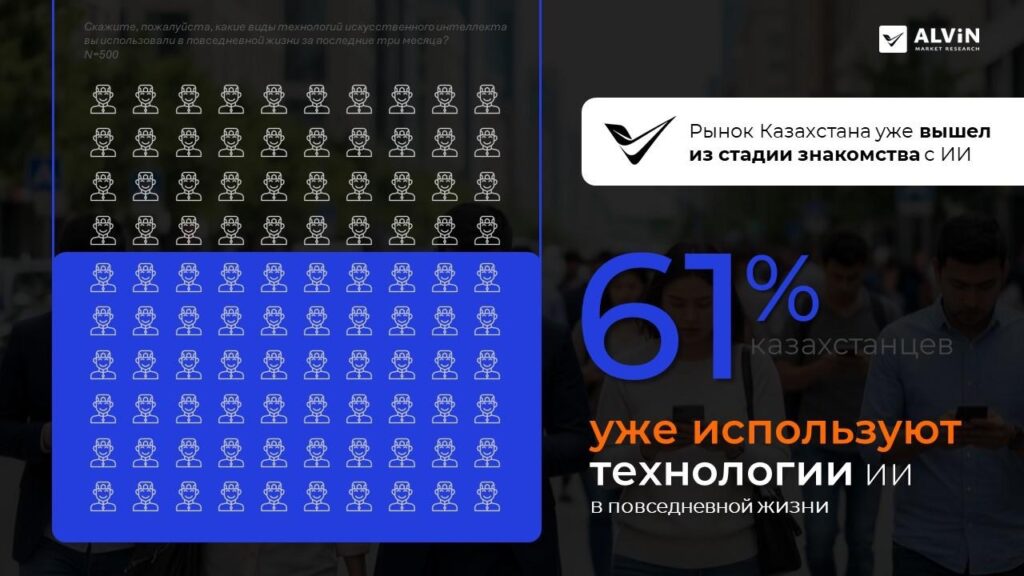
According to Alvin Market Research, 61% Kazakhs already use AI in their daily lives. This means that Kazakhstan has effectively passed the stage of familiarization with the technology: AI is no longer perceived as a tool for a small group of advanced users and has become part of everyday life.
The use of AI has already become entrenched as a stable habit.
36% users make up the "core"—people who access AI regularly, practically daily. Another third use it several times a week. And only 31% remain on the fringes, using it infrequently.
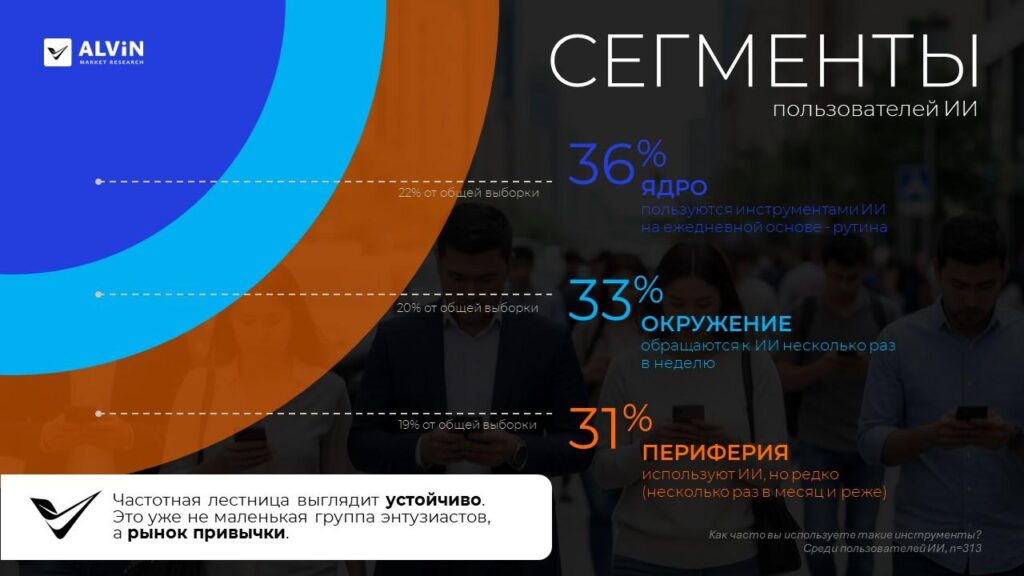
This is a fundamental signal for the market. When technology becomes a habit, it begins to change behavior—including consumer behavior.
Chatbot becomes the new search
One of the most significant changes is happening in the way users search for information.
While the customer journey once began with a search engine, dozens of tabs, and independent analysis of information, today more and more users simply ask AI a question and receive a ready-made answer.
According to the study, chatbots have become the primary interface for interacting with AI. They enable users to receive recommendations, compare options, clarify specifications, and make preliminary purchasing decisions.
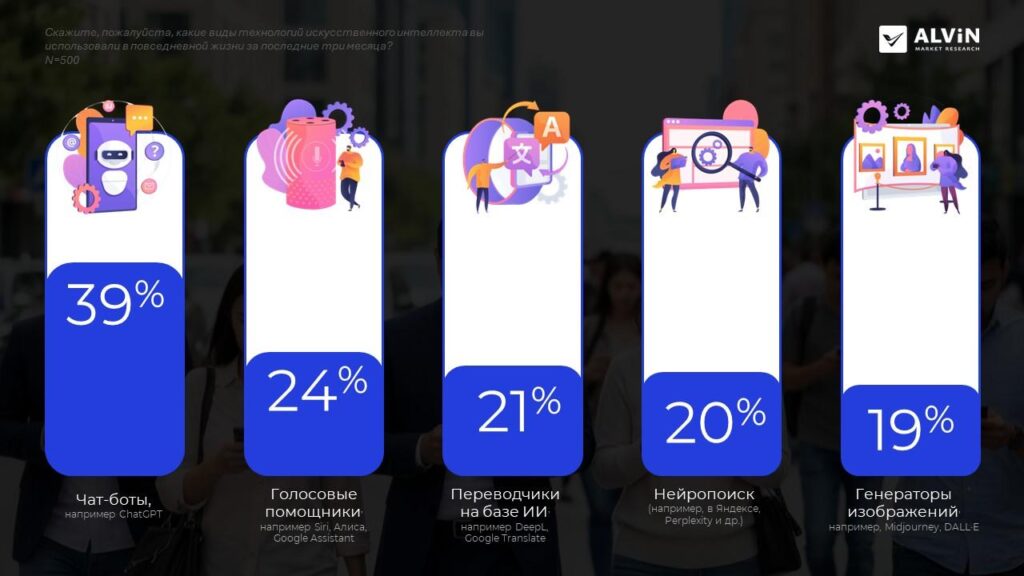
In fact, the chatbot is starting to take over the role that Google previously occupied.
If businesses previously fought for a place in search results, now they fight for a place in the response of artificial intelligence.
Today, it's no longer enough for a brand to simply have an online presence. It's crucial to be understandable to AI algorithms:
- have structured information,
- clear descriptions,
- transparent characteristics,
- comparable advantages,
- uniform data across all platforms.
Because it is this information that becomes the basis for the response that the user receives from neural networks.
The user began delegating choices to the algorithm
The most powerful transformation begins at the stage of comparing alternatives.
Previously, users had to navigate the entire selection process themselves: reading reviews, comparing websites, analyzing specifications, and studying reviews. This required time, attention, and cognitive effort.
Today, AI is starting to do more and more of this work.
The user comes to artificial intelligence with very pragmatic tasks:
- compare products,
- find the best offer,
- understand the characteristics,
- evaluate alternatives,
— get a recommendation.

In fact, AI is starting to act as a personal analyst, reducing the complexity of choice and saving time.
And here a fundamental behavioral shift occurs: the user begins to delegate to the algorithm not only the search for information, but also part of the decision-making process itself.
Loyalty ceases to be inertial
It is at this point that the usual model of loyalty begins to collapse.
For a long time, a significant portion of brand loyalty was inertial. Users bought familiar products not always because they were the best option, but because searching for alternatives was too difficult and time-consuming.
AI dramatically lowers this barrier.
Today the algorithm is capable of doing the following in seconds:
— compare brands,
- show alternatives,
- explain the differences,
— select an option for a specific request.
This is precisely why the very logic of competition is changing.
A study by Alvin Market Research shows that more and more consumers are already using AI to compare products and services, have experience doing so, or are willing to try it.
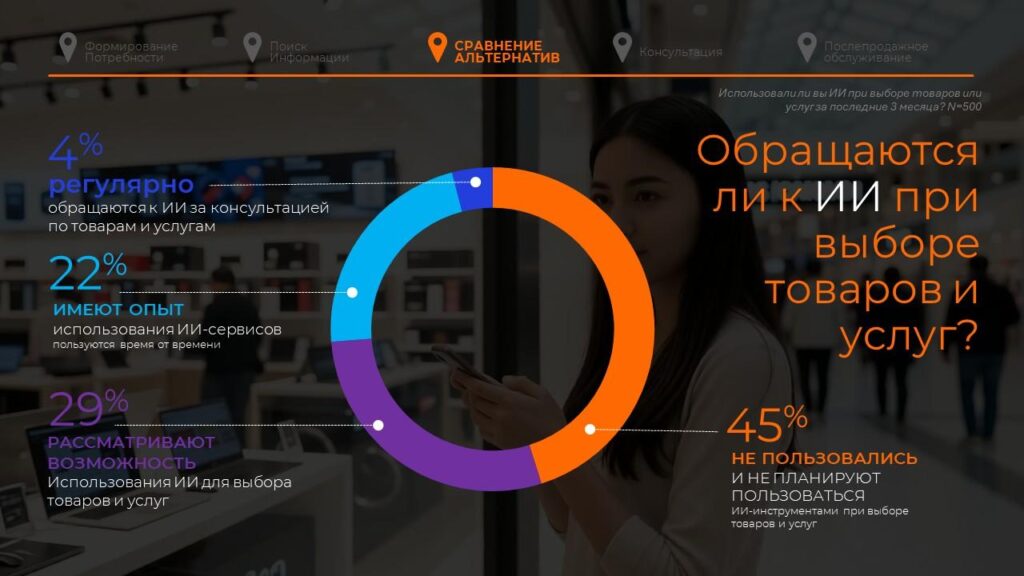
The main shift is that AI is starting to generate a shortlist of brands for the user.
If before the fight was for attention, now it’s for inclusion in this shortlist.
Users increasingly simply ignore anything that isn't recommended by the algorithm. This is already a new market model.
Particularly strong influence in complex categories
The impact of AI is most noticeable where choices are difficult and the cost of error is high.
The study shows that Kazakhstanis are most likely to consult with AI when choosing:
- electronics and household appliances,
- travel,
- education.

These categories share one common feature: it is difficult for the user to independently process the entire volume of information and assess the risk of error.
This is why AI is beginning to play the role of an external «cognitive assistant» that helps reduce uncertainty.
For businesses, this represents a significant shift: competition is increasingly taking place not directly between brands, but between how they are interpreted by an algorithm.
Brands are starting to lose direct control over choice
Another important finding of the study is that AI is changing not only search, but also user expectations of brands themselves and their advertising messages.
For example, 80% Kazakhstanis consider labeling of content created using artificial intelligence mandatory.

For the audience, the lack of transparency in brand communications begins to be perceived as an attempt at manipulation.
What businesses should do now
The main mistake many companies make is viewing AI as an experimental technology. In reality, we're already talking about a wholesale restructuring of the entire customer interaction logic.
A study by Alvin Market Research shows that the market is already undergoing transformation. While most users are still using AI in a targeted manner, some audiences are already using it throughout the entire customer journey—from need to purchase.

This is why it is important for businesses to adapt now.
The brand must be understandable to AI:
- clear characteristics,
- structured descriptions,
- comparisons,
- agreed information,
- informative reviews.
Companies will have to adapt to a new model of user behavior, where more and more decisions are made not after viewing an ad, but after recommendations from an algorithm.

And the main conclusion here is quite stark for the market: in the coming years, it won't just be brands competing with each other. Brands will be competing for a place in the AI response.
Because this is where consumer choice increasingly begins.
The study was conducted by Alvin Market Research in March 2026 using a CATI telephone survey among Kazakhstan's population aged 16 to 64. The sample size was 500 respondents. Both urban and rural residents were included, allowing for a more accurate assessment of the actual level of AI penetration and consumer behavior in the country. The data were weighted by gender, age, and region of residence to ensure representative results.